religion

Criteria:
  • Keywords = religion
  • [Funeral invitation and souvenir card]. by HUYSMANS, Joris-Karl. HUYSMANS, Joris-Karl. ~ [Funeral invitation and souvenir card]. Paris: [Maison Henri de Borniel, card by Louis de Bary in Rheims], 1907.
    Huysmans died on 12 May, 1907 after a long illness. He had dictated the text of his funeral invitation In his last days, having reportedly… (more)

    Huysmans died on 12 May, 1907 after a long illness. He had dictated the text of his funeral invitation In his last days, having reportedly seen the handsome black-edged funeral notice of an acquaintance. Calling himself homme de lettres, adding his presidency of the Académie des Goncourt and membership of Légion d’Honneur, he simply states that he died ‘muni des Sacrements de l’Eglise’ (fortified by the sacraments of the church). It begins with the address ‘M[onsieur]’ for the addition of a recipient’s name, but it is blank here. The souvenir card is similarly black-edged and contains short excerpts from five of Huysmans’ works: En Route, La Cathèdrale, Sainte Lydwine, L’Oblat and Les Foules de Lourdes. The funeral took place at the church of Notre-Dame-des-Champs, and Huysmans was buried in the cemetery of Montparnasse — clothed, according to his last wishes, in the garb of a Benedictine monk. Banks, The Image of Huysmans, p. 205,

    (see full details)
    View basket More details Price: £750.00
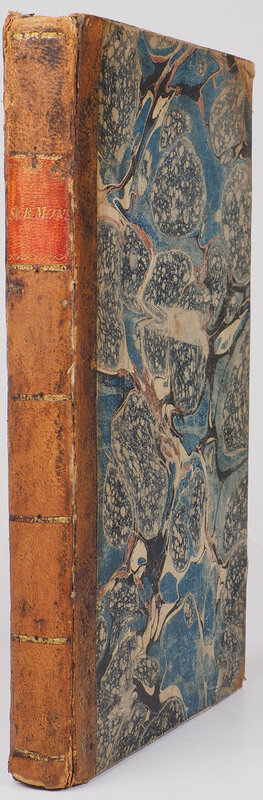
  • Sermons sur divers textes de L'Ecriture Sainte. by CAILLARD, Gaspar. CAILLARD, Gaspar. ~ Sermons sur divers textes de L'Ecriture Sainte. Dublin: pour J. Smith & W. Bruce, 1728.
    First edition of these sermons by a French Huguenot emigré pastor in Dublin. The first two sermons are on the subject of religious toleration: ‘Contre… (more)

    First edition of these sermons by a French Huguenot emigré pastor in Dublin. The first two sermons are on the subject of religious toleration: ‘Contre l’Intolerance’ and ‘Les justes bornes de la Tolerance’. The Toleration Act had been enacted in Ireland in 1719, granting Dissenters freedom of worship and allowed them to run schools. Caillard argues that not only was intolerance immoral, but irrational and imprudent. ‘It is imprudent since enforcing a set of beliefs undermines society: it leads groups to take a defensive stance against other groups, destroying public order. It is irrational since, while coercion can lead people to accept a belief outwardly, it cannot alter their inner convictions. It is immoral because coercion’s inability to change inner beliefs means it can only breed lies and hypocrisy, and because individuals have the right to self-determination. However this toleration was not to be extended to Catholics. The sermon was preached on 5th November, commemorating the failure of the Gunpowder Plot. In a later sermon, Caillard established the limits of toleration. While still endorsing the individual right to self-determination, Caillard argues there is a limitation on religious freedom: that such freedom not be harmful to religion in general or society as a whole.’ (Toleration in 18th century Ireland, Irish Philosophy.com)

    The book includes a subscriber’s list of men and women, both of Irish and French extraction. Among them is the name of moral philosopher Francis Hutcheson, then resident in Dublin. It is not difficult to trace a connection between Caillard’s arguments for tolerance based on circumstances and Hutcheson’s theories of moral rights, including the right to free conscience — which were later to have a profound influence on both the French and American constitutions. Outside Europe we find copies at Illinois, Charleston and Penn only.

    (see full details)
    View basket More details Price: £1,500.00
  • Die Zehn Gebote Gottes [The Ten Commandments, in German]. by BURTSCHELL, FR. BURTSCHELL, FR. ~ Die Zehn Gebote Gottes [The Ten Commandments, in German]. [Bingen am Rhein, 24 July 1887].
    A superb illuminated Ten Commandments, with the German text in calligraphic gothic script, beneath a title ‘Die Zehn Gebote Gottes’ arranged on a rainbow forming… (more)

    A superb illuminated Ten Commandments, with the German text in calligraphic gothic script, beneath a title ‘Die Zehn Gebote Gottes’ arranged on a rainbow forming a partially arched top to the sheet. The background contains a rich array of iconography in the style of a medieval manuscript, including Adam and Eve in paradise at the head on a decorated gold background, God in the heavens (with sun, moon and star), personifications of each of the sins, all arranged around a central tree of life linking heaven and earth. The central scene, on a silver mandala is a betrothal or wedding scene. Perhaps most striking of all is the rich azure ground, stippled with silver and overlaid with scrolling branches and leaves, inhabited by birds and animals. It is a splendid example of late nineteenth-century medievalism, and the revival of the art of manuscript illumination, experienced in Germany as much as in other European countries, especially in the context of the revival of Roman Catholicism. The revival in Germany has been studied in detail by Michela Braesel (see ‘Medieval Elements in Nineteenth-Century German Illumination. Context and Models’ in The Revival of Medieval Illumination, ed. Thomas Coomans & Jan de Maeyer, Leuven, 2007). Little more has been discovered of the artist and the recipient, except that they were both members of a large Bingen family, of who several members appear to have emigrated to the United States.

    (see full details)
    View basket More details Price: £2,500.00
  • LYDIS, Mariette, Armand GODOY. ~ Le Drame de la Passion. Paris: [A. & F. Debeauve, under the direction of G. Govone for] Émile-Paul frères, 1929.
    First edition, number 10 of 11 copies on Japon (which was followed by 500 copies on Hollande, total edition 511), with the etched frontispiece by… (more)

    First edition, number 10 of 11 copies on Japon (which was followed by 500 copies on Hollande, total edition 511), with the etched frontispiece by Lydis, depicting Christ as the Man of Sorrows. Cuban-born Armand Godoy was an important collaborator for Lydis. ‘Le Drame de la Passion, the most grandiose subject yet attempted by Godoy, is a musical tragedy in three acts; the characters are taken literally from the Bible with the addition of allegorical figures and types representing various aspects of humanity and nature, and of a chorus’ (French Review, 8, 2, Dec. 1934, pp. 145).

    (see full details)
    View basket More details Price: £300.00
  • Les Litanies de la Vierge. 48 lithographies enluminées... by Mariette LYDIS, illustrator, Armand GODOY. Mariette LYDIS, illustrator, Armand GODOY. ~ Les Litanies de la Vierge. 48 lithographies enluminées... Paris: [printed by Audin in Lyon and Dorfinant in Paris for] A. Blaizot et fils, 1934.
    First edition with the Lydis illustrations. One of a total edition of 131 copies, this one of the 115 on papier de Rives). The illustrations,… (more)

    First edition with the Lydis illustrations. One of a total edition of 131 copies, this one of the 115 on papier de Rives). The illustrations, many in the style of illuminated miniatures or icons, are transformed through brilliant pochoir colouring executed in the workshop of master colourist Jean Saude, reproducing the artist’s signature on each.

    These verse litanies, after the traditional catholic Marian litany, are entirely the creation of Armand Godoy and were first published (unillustrated) in 1930. Symbolist poet Godoy was born in Havana in 1880 and spent the first part of his life in Cuba and Peru, working in banking and the tobacco trade, before emigrating to France in 1919 with the express intention of becoming a poet ‘dans la langue de Baudelaire’. Much influenced by the Parnassians and the symbolists he was also a major collector of books, manuscripts and prints, amassing an unrivalled collection of Baudelaireiana. Among his numerous small-scale published works in French is his translation of Poe’s RavenLe Corbeau d’Edgar Poe (Émile-Paul frères, 1929, with a frontispiece by Lydis). Worldcat lists copies at Princeton and Bridwell only outside continental Europe (to which we add the Edinburgh copy.

    (see full details)
    View basket More details Price: £1,500.00
  • Le Livre de Goha le simple. by LYDIS, Mariette, illustrator. ADÈS, Abert and Albert JOSIPOVICI. � LYDIS, Mariette, illustrator. ADÈS, Abert and Albert JOSIPOVICI. � ~ Le Livre de Goha le simple. Paris: La Connaissance, 1926.
    First edition with illustrations by Mariette Lydis. Le Livre de Goha le simple, by two Egyptian Jewish authors, first appeared in 1919 (Calmann-Lévy) but this… (more)

    First edition with illustrations by Mariette Lydis. Le Livre de Goha le simple, by two Egyptian Jewish authors, first appeared in 1919 (Calmann-Lévy) but this 1926 deluxe illustrated edition formed part of the Collection de chefs-d’oeuvre series. It was an important commission for Lydis. Goha the Fool was immensely popular, having narrowly missed the 1919 Goncourt prize (which went to Proust that year). ‘It is possible to see the beginning of Levantine literature ― rooted in the realities of the Middle East and influenced by European culture ― in Goha le Simple … This sad and cynical love story, which employs the prototype of Goha, the hero of many Middle Eastern tales describes the lives of the common folk of Cairo before the spread of Western cultural influence’ (Mongrels or Marvels: the Levantine Writings of Jacqueline Shohet Kahanoff, ed. Starr & Somekh, 2011). Lydis’s illustrations, evidently reduced from larger drawings are striking ― mostly depicting women of all ages and classes. This is one of 1000 copies on Rives (after 100 on Hollande and 100 on Annam).

    (see full details)
    View basket More details Price: £700.00
  • LYDIS, Mariette. ~ [Sainte Vierge]. Paris, 1929.
    Number 9 of 100 copies of a separately-issued lithograph, coloured by the artist and exhibited at London’s Leicester Gallery in 1935. A reviewer in The… (more)

    Number 9 of 100 copies of a separately-issued lithograph, coloured by the artist and exhibited at London’s Leicester Gallery in 1935. A reviewer in The Connoisseur wrote of that exhibition:
    ‘February’s triple bill at the Leicester Galleries began with a display of paintings, drawings and prints by Mariette Lydis, a Viennese, domiciled in Paris. She has been a prolific illustrator. No fewer than thirty volumes with drawings by her have been published, copies of which have been acquired by many of the principal national libraries. Her work may be seen in the public galleries of Paris — the Jeu du Paume and the Luxembourg — of Milan, Amsterdam, Vienna, Leipzig, and elsewhere. She has also been accorded the honour of having a self-portrait received in the Uffizi Gallery. Her travels have taken her all over Europe, to America and to Morocco, and she is said to be entirely self-taught.
    In the drawings, which seem to be mainly studies or projects, her attitude, and quite rightly, appears to be objective. Often her subjects are viewed as so much still-life, but they show considerable delicacy, if not variety, in handling. Her paintings evince, especially in such subjects as the dream-like Nuages, more of imagination and more of sensibility. Sainte Vierge Enfant has a pleasant cameo-like quality, and Javanaise, considerable attractiveness. For ourselves, we find her most interesting in her etchings and lithographs. A series of the latter, entitled L’Art d’Aimer and the map like Oracle, are both imaginative and original’.

    (see full details)
    View basket More details Price: £600.00
  • 42 Miniaturen zum Koran. by LYDIS, Mariette. LYDIS, Mariette. ~ 42 Miniaturen zum Koran. Berlin: Brandus’sche Verlagsbuchhandung, [ 1924].
    First edition of Lydis’s exquisite illustrations for selected passages from the Qur’ān, inspired by Persian miniatures. The plates, in colours and gold, were printed by… (more)

    First edition of Lydis’s exquisite illustrations for selected passages from the Qur’ān, inspired by Persian miniatures. The plates, in colours and gold, were printed by Ganymed in Berlin, the text by Poeschel & Trepte in Leipzig. The book is known with several publishers’ bindings, and is here in its most striking form, with a vellum spine and marbled paper covers and slipcase (resembling Rorschach tests).

    The Koran, and the miniatures Lydis created from it represent a Damascene moment in the artist’s career. They are reproduced here from her originals painted on vellum, made while she was still living in a villa outside Athens with her second husband, Jean Lydis. She later recalled their inception:

    ‘One day I found a copy of the Quran in the bookshop, and absorbed in reading it, finding it so full of wisdom, I suddenly decided that I had to illustrate it. Today I realize the audacity of that decision: I had no experience, nor did I possess any technique, I only felt the impatience to obtain the parchments necessary to start working.
    I executed the illustrations like Persian miniatures, full of details in the landscapes and the clothing; for the first time I felt the benevolent fever of continuous work, day and night absorbed in my drawings and my colours.
    In a few months I completed 42 illustrations, meticulous and colourful; I didn’t know whether they were magnificent or insignificant, but I loved them and was obsessed to the point of buying a small safe to protect them in case the villa caught fire. The house did not burn down, and my Quran, my first child, was finally published and sold out. Today I look at it without emotion, although it was decisive for my career as an artist. Many other illustrations followed it, and we are unfaithful to our works. Nevertheless, I could say that until now none of them has provoked in me the same intoxication as that work, which sprang from me like a fountain, effortlessly and before even thinking whether I could accomplish such a thing.
    With my Quran completed I set out for Paris and London in search of a publisher; after a long pilgrimage I found someone interested [in Germany], and left with my contract in my pocket. That was more than satisfaction; it was the affirmation of a feeling and of the hope that had grown in me during months of work: that my paintings could produce in other people an emotion similar to mine, that I had the possibility of communicating to others what I wanted them to feel, something priceless and unpredictable for an artist. To always give the best of oneself. What one achieves seems (at least for the moment) like a realisation, an entity. Who could ever know how the public will react, what their judgement will be? Will they feel sympathy, aversion, tenderness, or hostility toward what they see before them? That public will be their judge, their friend, or their executioner. (Translated from an excerpt from Lydis’ 1942 Buenos Aires memoir, in Spanish, reproduced in Correa, En Busca de Mariette Lydis, pp. 73-4)

    (see full details)
    View basket More details Price: £900.00
  • Exercises de piété pour la Communion. Nouvelle Édition, augmentée de trente-six courtes Méditations sur quelques passages de l’Écriture-Sainte et de quelques cantiques. by (BERLIN WORK). (BERLIN WORK). ~ Exercises de piété pour la Communion. Nouvelle Édition, augmentée de trente-six courtes Méditations sur quelques passages de l’Écriture-Sainte et de quelques cantiques. Lausanne: [Bonamic et compagnie for] Georges Bridel, 1845.
    A most attractive Catholic primer for the communion, evidently bound as a gift with an unusual Berlin work embroidered panel. ‘Berlin wool work is embroidery… (more)

    A most attractive Catholic primer for the communion, evidently bound as a gift with an unusual Berlin work embroidered panel. ‘Berlin wool work is embroidery with Berlin wools or any type of thread or beads on canvas by means of copying a coloured chart known as a Berlin pattern. Almost exclusively confined to the 19th century, Berlin wool derived its name from the wool that came from Merino sheep in Saxony. It was taken to Gotha to be spun and on to Berlin to be dyed... Prior to the introduction of Berlin patterns it was very rare to find any indication about the choice of colour or threads. Berlin patterns were always coloured by hand at first, until the emergence of industrial printing techniques’ (V&A). Though the style originated in Germany, Berlin work was enthusiastically practised by women all over Europe and in North America

    (see full details)
    View basket More details Price: £750.00
  • Christ as the Man of Sorrows supported by two angels standing in a chalice or grail. by [THE TRIUMPH OF THE EUCHARIST, [THE TRIUMPH OF THE EUCHARIST, ~ Christ as the Man of Sorrows supported by two angels standing in a chalice or grail. Italian, in the style of Remondini family, ?Bassano, later seventeenth century].
    The holy grail — the crucified Christ standing within a chalice, his wound from the soldier’s spear bleeding freely into it, his arms supported by… (more)

    The holy grail — the crucified Christ standing within a chalice, his wound from the soldier’s spear bleeding freely into it, his arms supported by angels. A host of kneeling figures with candles, one swinging a censer kneel on either side. The lower panel depicts the Last Supper (complete with a small dog) with the text: ‘Sia laudato il santissimo sacramento’ (’Let the most holy sacrament be praised’). Early Christian tradition held that Christ’s blood was collected by Mary Magdalen at the time of the crucifixion in a vessel, though in images like this the symbolism is developed to depict blood flowing directly into the chalice in which Christ stands, emphasising the traditional connection between this vessel and the cup used at the Last Supper, and expressing the essence of transubstantiation at the Eucharist.

    The image may be comprised of two woodblocks, though the borders are continuous around the whole print. Though probably dating from the seventeenth century, the block was clearly old when this impression was made, it shows some degradation, cracking and several circular wormholes. The area around Christ’s face is notably rubbed and soiled, possibly from kissing or touching as a mark of pious veneration.

    (see full details)
    View basket More details Price: £900.00
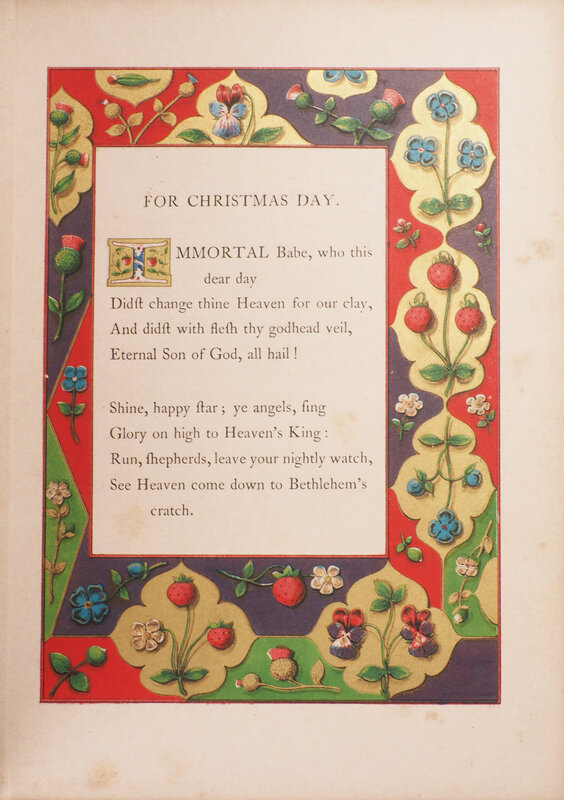
  • Parables of our Lord. by [HUMPHREYS, Henry Noel]. [HUMPHREYS, Henry Noel]. ~ Parables of our Lord. London: Longman & Co., 1847.
    First edition, an excellent copy, of one of the earliest of Humphreys’ well known medieval revivalist publications, entirely printed in colour in imitation of illuminated… (more)

    First edition, an excellent copy, of one of the earliest of Humphreys’ well known medieval revivalist publications, entirely printed in colour in imitation of illuminated manuscripts. Parables of our Lord was issued both in this elaborate stamped black calf binding and a heavier papier mâché binding. The latter often broke the gutta percha binding of the book, leaving the pages loose. In this calf copy all pages are secure.

    The colophon reads: ‘In designing the ornaments to the sacred parables contained in this volume, the illuminator has sought to render them in each instance appropriate. The work of illumination was commenced on the first day of May the year of Our Lord MDCCCXLV and terminated on the tenth day of Febry. MDCCCXLVI. HNH.’ McLean, Victorian Publishers’ Book-bindings in Paper p. 13, 51; McLean, Victorian Book Design and Colour Printing (2nd ed.) p. 99-103 and 210.

    (see full details)
    View basket More details Price: £800.00
  • Retour de l’enfant prodique Évangile selon saint Luc. by BERQUE, Jean, illustrator. BERQUE, Jean, illustrator. ~ Retour de l’enfant prodique Évangile selon saint Luc. [Paris: Philippe Gonin for Gustave-Édouard Gentil, 7 April 1933.
    A superb version, with original illustrations, of the parable of the Return of the Prodigal Son, from the Gospel of St Luke. Number 6 of… (more)

    A superb version, with original illustrations, of the parable of the Return of the Prodigal Son, from the Gospel of St Luke. Number 6 of just 25 copies, each with 16 original signed gouaches by Berque, this being copy number VI.

    Jean Berque (Reims, 1896 – Paris, 1954), painter and illustrator, was son of a Champagne wine producer. A student of the Nabis, Félix Vallotton, Maurice Denis and Paul Sérusier, he was one of the first members of the Union Rémoise des Arts Décoratifs and created the Stations of the Cross for the Saint-Nicaise church in Reims. Renowned for his nudes, he exhibited at the Salon d’Automne from 1924 to 1928 and at the Salon des Tuileries between 1927 and 1934. He is best known as a book illustrator and collaborated with François-Louis Schmied (whose inspiration is clear in this work), Philippe Gonin and the Gonin brothers, from Lausanne. He illustrated works by André Gide, Pierre Louys, Colette, Montherlant, André Maurois, Paul Claudel, Anna de Noailles and Paul-Jean Toulet, as well as The Song of Songs.

    (see full details)
    View basket More details Price: £3,250.00
  • Biblia Bibliorum opus sacrosanctum vulgatis quidem characteribus, sed incredibili studio... Accessit etiam Tertium Maccabeorum liber nouissime additus, quem priores impressiones non habebant... by [HAGUÉ, Théodore, binder and forger]. [HAGUÉ, Théodore, binder and forger]. ~ Biblia Bibliorum opus sacrosanctum vulgatis quidem characteribus, sed incredibili studio... Accessit etiam Tertium Maccabeorum liber nouissime additus, quem priores impressiones non habebant... [Lyon: [Jean Mareschal], 1536.
    A large and splendid binding - of one of the notorious forgeries created by Théodore Hagué (1822-1891) one of a considerable number purporting to have… (more)

    A large and splendid binding - of one of the notorious forgeries created by Théodore Hagué (1822-1891) one of a considerable number purporting to have been made for Henri II and his mistress, Diane de Poitiers. Hagué (1822-1891) had worked in London for Zaehnsdorf but was living in France in the 1860s when he began creating pastiche bindings and then outright forgeries, offering them for sale first in 1862. It was not until 1875 when examples found their way to London via Bernard Quaritch, who had entered into correspondence with a certain M. Caulin who was offering choice renaissance books, many apparently formerly belonging to a lost collection of Henri II and Diane de Poitiers. Quaritch sold the books almost exclusively to the British collector John Blacker. ‘Needless to say, the ordeal ended well for no one involved: by 1888, John Blacker had spent approximately thirteen years and £36,000 (£3.4 million by modern reckoning) collecting forged bindings, Bernard Quaritch was forced to scramble to cover his losses and hopefully his involvement in the whole charade, and Hagué dropped dead suddenly in 1891. Blacker’s collection was sold at Sotheby’s for £1,907 16s 6d in 1897, which translates to a little over £205,000 in 2017. Henry Folger, who began his collecting in 1883 (when John Blacker was deeply invested in purchasing Caulin/Hague’s forged bindings), kept a copy of the 1897 catalog, which features multiple full-color images made with a combination of letterpress and chromolithography, rare (and expensive) for an auction catalog at the time’ (Elizabeth DeBold, Under Cover: forged Bindings on Display at the Folger, Folger Library Blog, July 19, 2018).

    Blacker’s sale included no less than nineteen books purporting to have been made for Henri II and Diane de Poitiers. This one, being a folio, has an especially expansive ‘Grolerieresque’ strapwork designs in black, white and gilt, a scheme continued in colours on the fully decorated gilt and gauffred edges. The design incorporates variations of both their monograms and devices, including Diane’s crescent moon devices (evoking Diane the Huntress, goddess of the moon, and her reputed iridescent beauty) and the famously ambiguous entwined ‘H’ and ‘D’ (the latter actually a ‘C’ for Henri’s Queen, Catherine, but easily readable as ‘D’ for Diana). Sotheby’s, Catalogue of a remarkable Collection of Books in magnificent modern Bindings, formed by an Amateur (recently deceased) (11 Nov. 1897), lot 15. Mirjam Foot, ‘Double Agent: M. Caulin and M. Hagué,’ Book Collector, Special Edition for the 150th Anniversary of Bernard Quaritch (1997), pp. 136-150. Adams B102; Von Gültlingen, Mareschal 14.

    (see full details)
    View basket More details Price: £8,500.00
  • [Painted miniature on vellum. by (DEVOTION) (DEVOTION) ~ [Painted miniature on vellum. ?France, late eighteenth century].
    A very finely painted devotional miniature with emblems of the Passion and Ressurection: a broken tree (with fire), a flaming heart, discard crowns, rosaries and… (more)

    A very finely painted devotional miniature with emblems of the Passion and Ressurection: a broken tree (with fire), a flaming heart, discard crowns, rosaries and a cross. In the background are leafy tress and a convent. In the sky is a glowing rebus and a tiny gold butterfly. The text below reads ‘Vuide [sic for ‘vide’] de tout hormis dieu fait son bonheur en ce bas lieu’, the second part of the phrase being rewritten over an erasure. The text, though not identical recalls that of Pascal’s Passion (’Oubli du monde et de tout, hormis Dieu’) — the text recalling his vision of 1654 found sewn into the lining of his coat found on his death.

    (see full details)
    View basket More details Price: £800.00
  • Heures nouvelles dediées au Roy, contenant les Offices, Vêpres, Hymnes, Proses & priores qui se disent à l’Eglise. En Latin & en François. by (DEVOTION). (DEVOTION). ~ Heures nouvelles dediées au Roy, contenant les Offices, Vêpres, Hymnes, Proses & priores qui se disent à l’Eglise. En Latin & en François. Paris: chez [Jean-Augustin] Grangé, Gallerie des Prisonniers, a la Sainte Famille, 1747.
    A diminutive French prayerbook for personal Catholic devotions with an interesting English provenance, inscribed by one Mary Radclyffe. Given that this is a Catholic prayer… (more)

    A diminutive French prayerbook for personal Catholic devotions with an interesting English provenance, inscribed by one Mary Radclyffe. Given that this is a Catholic prayer book there is a strong possibility that it was bought, owned and inscribed by Lady Mary Radclyffe (1732–1798) of an English Catholic family with longstanding links to the exiled Stuarts. Mary’s father, Charles, a Jacobite and freemason, was an illegitimate grandson of Charless II (by Moll Davis) and spent most of his life in exile in Europe. He took part in the Jacobite Riding of 1745 and was executed the following year. Mary Frances Guillelma Radclyffe was born at Rome in 1732 and married Francis Eyre of Warkworth Castle in February 1755. Their eldest daughter, Maria Eyre, was born later that year.

    (see full details)
    View basket More details Price: £750.00
  • The Communicant's Spiritual Companion. Or, an evangelical Preparation for the Lord’s Supper. In which I. The Nature of the Ordinance is shewn. II. The Dispositions requisite for a Profitable Participation thereof. Wherein The Careless Sinner is Admonished, The Formalist Detected and Reproved, The Feeble-Minded Comforted, The Doubting Relieved, The Sincere Assisted, and The Faithful Confirmed. With meditations and helps for prayer, suitable to the subject. by HAWEIS, Thomas. HAWEIS, Thomas. ~ The Communicant's Spiritual Companion. Or, an evangelical Preparation for the Lord’s Supper. In which I. The Nature of the Ordinance is shewn. II. The Dispositions requisite for a Profitable Participation thereof. Wherein The Careless Sinner is Admonished, The Formalist Detected and Reproved, The Feeble-Minded Comforted, The Doubting Relieved, The Sincere Assisted, and The Faithful Confirmed. With meditations and helps for prayer, suitable to the subject. Dublin: for Henry Whitestone, 1775.
    A rare Dublin edition of this popular spiritual guide by an important evangelical preacher, first published c. 1750 and several times reprinted in the eighteenth… (more)

    A rare Dublin edition of this popular spiritual guide by an important evangelical preacher, first published c. 1750 and several times reprinted in the eighteenth century. The adverts for other works published by Whitestone in Dublin includes a collected edition of Wesley, ‘elegantly printed’ in 32 volumes. ESTC T103515. BL and NLS only in ESTC/WorldCat.

    (see full details)
    View basket More details Price: £300.00
  • Insignia Archiepiscoporum Cantuariensium cum Etimologia Cognominum, Scutorumque descriptione - latine at anglice exposita - a Conquestu ad praesens tempus, fidelitur deducta. Orig[ina]le extat in Biblioth[eca] Lambethiana 1805. by (ARCHBISHOPS OF CANTERBURY). (ARCHBISHOPS OF CANTERBURY). ~ Insignia Archiepiscoporum Cantuariensium cum Etimologia Cognominum, Scutorumque descriptione - latine at anglice exposita - a Conquestu ad praesens tempus, fidelitur deducta. Orig[ina]le extat in Biblioth[eca] Lambethiana 1805. [England, 1806 or soon after].
    An antiquary’s heraldic manuscript of the arms of the archbishops of Canterbury from Lanfranc (d. 1089) to Charles Manner-Sutton (installed 1805) copied from a manuscript… (more)

    An antiquary’s heraldic manuscript of the arms of the archbishops of Canterbury from Lanfranc (d. 1089) to Charles Manner-Sutton (installed 1805) copied from a manuscript made for John Whitgift (archbishop 1583-1604) still in the library of Lambeth Palace (MS 555). Much of the heraldry relating to the archbishops of Canterbury is displayed in the church of St Mary-at-Lambeth in London, near to Lambeth Palace the London seat of the archbishops. The manuscript records the arms, together with some etymological explanations of names, and opens with the arms of the See of Canterbury. Included are the arms of Thomas Becket, Stephen Langton, Simon Sudbury, Thomas Cranmer, Reginald Pole, Matthew Parker, John Whitgift, Richard Bancroft and William Laud. It was in the collections of Sir Charles George Young (1795–1869), officer of arms who served in the heraldic office of Garter King of Arms, the senior member of the College of Arms in England, from 1842 until his death in 1869.

    (see full details)
    View basket More details Price: £850.00
  • by their London Intelligencer. And presented to the Lords of the Covenant of Scotland. Anno Domini. 1639. by THE SCOTS SCOUTS DISCOVERIES: THE SCOTS SCOUTS DISCOVERIES: ~ by their London Intelligencer. And presented to the Lords of the Covenant of Scotland. Anno Domini. 1639. London: for William Sheares, 1642.
    First edition of this Covenanter propaganda pamphlet of the era of the Bishops’ Wars, purporting to offer intelligence as to the parlous and divisive state… (more)

    First edition of this Covenanter propaganda pamphlet of the era of the Bishops’ Wars, purporting to offer intelligence as to the parlous and divisive state of the English nation, particularly the English forces, who the author ‘L.D.’ claims to have infiltrated. It is full of fascinating gossip and opinion, albeit mainly fictional, sometimes in verse form.

    ‘What will you fight for a Booke of Common Prayer?
    What will you fight for a Court of High Commission?.... [English]
    Wee fight to have our true Religion stand:
    Wee fight to keepe our Lawes unvilified...’ [Scots].

    The spy-narrator recounts various sorties into England. At Canterbury he visits Becket’s tomb and scrawls on the cathedral wall, hears a sermon at Lambeth, visits Guy Fawkes’s house and reports a dissolute Whitehall, with the King having fled. Wing L10 (another edition of 22 pages is L11); Thomason E.153[22].

    (see full details)
    View basket More details Price: £450.00
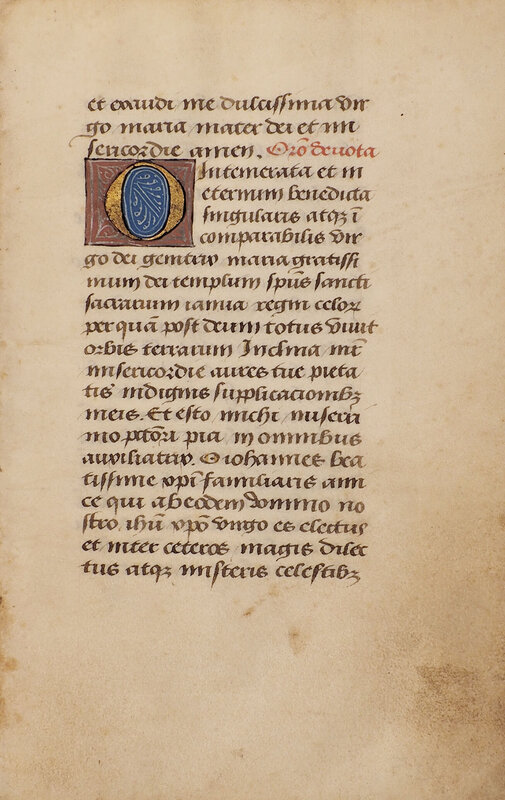
  • [Illuminated manuscript. by [MALLET, Sophie]. [MALLET, Sophie]. ~ [Illuminated manuscript. France, 1875].
    A delightful, accomplished and idsiosyncratic illuminated manuscript in neo-gothic style by a French woman, one Sophie Mallet, probably as a wedding gift for a female… (more)

    A delightful, accomplished and idsiosyncratic illuminated manuscript in neo-gothic style by a French woman, one Sophie Mallet, probably as a wedding gift for a female friend or relation: Jeanne or ‘JMN’. The texts include familiar words of advice for a young wife, scriptural and otherwise, while a section titled ‘Vie du monde’ includes personal and original advice addressed to ‘ma Jeanne’. Among the texts are: ‘Qui trouvera une femme forte?...’ (Proverbs 31 [incorrectly given as Ecclesiasticus here], ‘Who can find a virtuous woman? for her price is far above rubies’); ‘Bienheureux les pauvres d’esprit...’ (Matthew 5, Blessed are the poor in spirit, for theirs is the kingdom of heaven); ‘Faites comme les petits enfants qui de l’une des mains se tiennent à leur père’ (St Francis of Assisi, ‘Suffer Little Children to Come Unto Me’), and there are excerpts from the Imitation of Christ and from St Bernard.

    The real pleasure of the manuscript lies in its illumination, expertly done with unusual and quirky details. The borders include numerous recognisable birds, insects and flowers rendered in impressive detail. Colours are applied very skilfully as are metallic highlights, including burnished and liquid gold, often on raised or otherwise textured grounds. Best of all is the colophon or tailpiece, which includes an entwined pair of longtailed dragons looking more like dinosaurs than medieval beasts.

    (see full details)
    View basket More details Price: £2,600.00
  • Le nouvel Ange conducteur, ou Recueil de prièrs les plus propres à inspirer de la dévotion. Nouvelle édition, revue & considérablement augmentée. by [COURET, Jacques]. [COURET, Jacques]. ~ Le nouvel Ange conducteur, ou Recueil de prièrs les plus propres à inspirer de la dévotion. Nouvelle édition, revue & considérablement augmentée. Vesoul: Jean-Baptiste Poirson, 1782.
    With a delightful contemporary heart-shaped ex libris belonging to a young girl (probably the bookplate of Marie Josephe Briot, later Bartoulot of Belfond, Franche-Comté), d.… (more)

    With a delightful contemporary heart-shaped ex libris belonging to a young girl (probably the bookplate of Marie Josephe Briot, later Bartoulot of Belfond, Franche-Comté), d. 1840) A rare Vesoul imprint of a popular prayer book first published in 1681 and reprinted widely into the nineteenth century. The printer Poirson is not listed in the Répertoire d’imprimeurs/libraires (which lists a single Vesoul printer, Jean-Claude Bogillot, 168.-1760) though the CCFr does list a handful of ephemeral Poirson imprints of the 1790s.

    (see full details)
    View basket More details Price: £1,500.00